
Your deck is exposed to sun, rain, snow, humidity, dirt, and changing temperatures throughout the year. Over time, these conditions can cause wood to fade, dry out, crack, or lose its original appearance.
If your deck needs a refresh, you may be wondering: Should you stain it or paint it?
Both options can improve the appearance of an outdoor deck, but they provide different finishes and levels of protection. The right choice depends on the type and condition of your deck, the look you want, how much maintenance you are willing to do, and how the deck is used.
For homeowners in Toronto, Brampton, Mississauga, Oakville, Burlington, Vaughan, and surrounding GTA communities, understanding the difference between deck staining and painting can help you choose the right treatment for your outdoor space.
Is It Better to Stain or Paint a Wood Deck?
For most wood decks, staining is often preferred when homeowners want to maintain the natural appearance of the wood, while painting can be a better choice when they want a solid colour and greater visual coverage.
The best option depends on the condition of the wood and the desired finish.
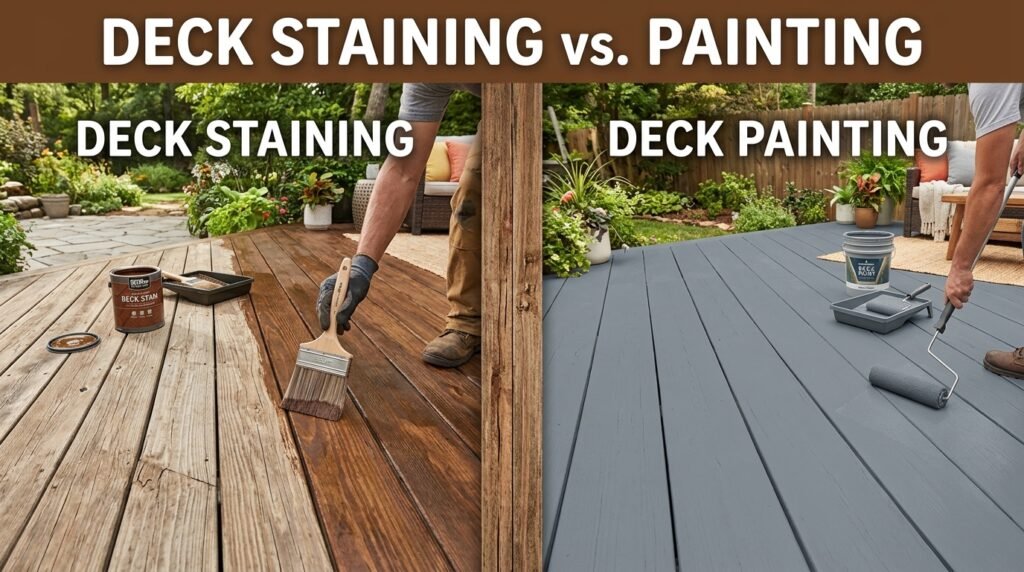
Deck Staining
Stain penetrates into the wood to varying degrees depending on the product and type. It can enhance the natural grain while providing colour and protection.
Deck Painting
Paint creates a film over the surface of the wood and provides a more uniform colour. It can cover imperfections and dramatically change the appearance of an older deck.
Neither option is automatically better for every deck.
Deck Staining vs. Painting at a Glance
| Feature | Deck Staining | Deck Painting |
|---|---|---|
| Appearance | Shows more natural wood grain | Provides a solid, uniform colour |
| Wood texture | Usually remains visible | Mostly covered |
| Colour choices | Many options, including transparent and solid stains | Wide range of colours |
| Maintenance | Depends on stain type and exposure | May require touch-ups and recoating |
| Surface preparation | Important | Extremely important |
| Best for | Maintaining a wood appearance | Creating a bold, consistent finish |
| Natural look | Excellent | Limited |
| Hiding imperfections | Limited with transparent stains | Better coverage |
| Application | Requires proper wood preparation | Requires thorough preparation and priming where appropriate |
1. Choose Staining if You Want a Natural Wood Look
One of the biggest advantages of deck staining is its ability to preserve the appearance of natural wood.
A suitable stain can enhance:
- Wood grain
- Natural texture
- Wood colour
- Overall character
This can be especially attractive when your deck is made from good-quality wood that still has an appealing grain pattern.
If you like the natural character of your deck, staining may be the better option.
2. Choose Painting if You Want a Completely New Look
Painting gives you more freedom to create a specific colour scheme.
Instead of highlighting the existing wood grain, paint can provide a consistent appearance across the deck.
You could choose a colour that complements:
- Exterior walls
- Siding
- Doors
- Trim
- Landscaping
- Outdoor furniture
Painting can also help cover visual imperfections that would remain visible with a transparent stain.
However, paint should not be viewed as a way to hide serious structural or moisture-related problems. Damaged wood should be repaired or replaced before applying a finish.
3. Consider the Condition of Your Deck
The existing condition of the wood should be one of the first things you evaluate.
Check for:
- Cracked boards
- Splintering
- Rot
- Loose fasteners
- Discolouration
- Peeling finishes
- Mould or mildew
- Water damage
If boards are structurally damaged, refinishing alone will not solve the problem.
Professional preparation may involve cleaning, sanding, scraping, repairs, or replacement of damaged boards before the new finish is applied.
4. Deck Staining Can Highlight Wood Grain
If your deck has attractive wood grain, stain can enhance it instead of covering it.
This is one reason many homeowners prefer stain for traditional wood decks.
Different stain types provide different levels of opacity.
Transparent Stain
Provides minimal colour while allowing most of the natural appearance to remain visible.
Semi-Transparent Stain
Adds more colour while still allowing wood grain to show through.
Solid Stain
Provides stronger colour coverage while retaining some of the visual character of the wood.
The appropriate product depends on your desired appearance and the condition of the existing surface.
5. Painting Provides More Consistent Coverage
If the wood is heavily weathered or visually inconsistent, paint can provide a more uniform appearance.
For example, an older deck may contain boards with different colours because of uneven sun exposure and previous staining.
A solid-colour finish can make the entire deck look more consistent.
However, painting a deck requires excellent surface preparation because moisture and foot traffic can cause problems if the coating does not properly adhere.
6. Think About Maintenance
Neither staining nor painting is completely maintenance-free.
Your deck’s exposure to:
- Direct sunlight
- Rain
- Snow
- Moisture
- Foot traffic
- Furniture
- Dirt
can affect how long the finish remains attractive.
Regular maintenance should include inspecting the deck, cleaning the surface, removing accumulated debris, and addressing damage before it becomes more serious.
The exact maintenance schedule depends on the product, exposure, wood type, and condition of the deck.
7. GTA Weather Matters
Outdoor decks in the GTA experience significant seasonal changes.
A deck may go through:
Spring: Rain and moisture
Summer: Heat and UV exposure
Fall: Leaves, moisture, and temperature changes
Winter: Snow, freezing temperatures, and freeze-thaw conditions
These conditions can affect both the wood and the finish.
That makes proper preparation particularly important.
Applying a coating to dirty, damp, or poorly prepared wood can result in an uneven appearance or premature failure.
8. Preparation Is More Important Than Many Homeowners Realize
One of the most common mistakes is focusing heavily on the stain or paint while overlooking preparation.
Before refinishing, the deck may need to be:
- Thoroughly inspected
- Cleaned
- Stripped if necessary
- Sanded where appropriate
- Repaired
- Allowed to dry properly
- Prepared for the selected coating
The exact preparation process depends on the existing finish and condition of the wood.
A new coating cannot compensate for a poor surface.
9. Can You Paint Over a Previously Stained Deck?
Sometimes, but it depends on the existing stain, surface condition, and the new coating system.
Simply painting over an old, peeling, dirty, or incompatible finish can lead to adhesion problems.
The existing surface should be evaluated and properly prepared before applying paint.
In some cases, removing or sufficiently preparing the previous coating may be necessary.
If you are unsure about the existing finish, professional assessment can help determine the appropriate preparation method.
10. Can You Stain a Previously Painted Deck?
This is generally more complicated than changing from one stain to another.
If the existing paint forms a film over the wood, a penetrating stain may not absorb properly.
The old coating may need to be removed or extensively prepared before a new stain can be considered.
The condition of the deck and the type of existing coating should be evaluated before choosing the next finish.
Which Option Lasts Longer?
There is no universal answer because durability depends on several factors.
These include:
- Product quality
- Surface preparation
- Wood condition
- Weather exposure
- Foot traffic
- Application method
- Maintenance
- Previous coatings
A high-quality product applied to a properly prepared surface can generally perform better than an expensive product applied over a poorly prepared deck.
The goal should be to select the right coating system and preparation process rather than focusing only on the expected lifespan.
Should You Stain or Paint an Old Deck?
For an older deck, the decision should start with the condition of the wood.
Staining may be suitable when:
- The wood is structurally sound.
- You want to preserve visible grain.
- The surface can be properly prepared.
- You prefer a natural appearance.
Painting may be suitable when:
- You want a solid colour.
- The wood has visual inconsistencies.
- You want stronger colour coverage.
- You prefer a more uniform appearance.
If the deck has significant rot, structural damage, or severely deteriorated boards, repair or replacement may be necessary before refinishing.
How to Choose the Right Deck Finish
Ask yourself these questions:
Do I want to see the natural wood grain?
If yes, stain may be the better choice.
Do I want a completely different colour?
Paint or a solid stain may provide more suitable coverage.
Is the existing wood attractive?
If the wood has a good natural appearance, staining can enhance it.
Is the deck heavily weathered?
A solid finish may provide better visual coverage, but preparation remains essential.
How much maintenance am I willing to perform?
Both finishes require ongoing care, so consider your maintenance expectations before choosing.
Final Thoughts
The decision between deck staining and painting ultimately comes down to the appearance you want, the condition of your deck, and how you plan to maintain it.
Staining is an excellent choice when you want to preserve and enhance the natural character of wood. Painting can be better when you want a bold, consistent colour and more complete visual coverage.
Regardless of which option you choose, proper preparation is one of the most important factors in achieving a durable and attractive result.
For GTA homeowners, seasonal weather makes regular deck maintenance especially important. Addressing worn finishes, damaged boards, dirt, and moisture issues early can help keep your outdoor space looking better for longer.
Ready to Refresh Your Deck?
Pro Renewal Services Inc. provides professional deck staining and home improvement services for homeowners in Brampton, Toronto, Mississauga, Oakville, Burlington, Vaughan, and surrounding GTA communities.
Whether your deck needs cleaning, preparation, staining, or other exterior improvements, our team can help you choose an approach suited to your property’s needs.
Contact Pro Renewal Services. today to discuss your deck project and request a free estimate.
Frequently Asked Questions
Is staining better than painting a deck?
Neither option is universally better. Staining is generally preferred for maintaining natural wood grain, while painting provides a solid and uniform colour.
What lasts longer on a deck, paint or stain?
Durability depends on the product, wood condition, preparation, application, weather exposure, and maintenance. Proper preparation is essential for either finish.
Can I paint over deck stain?
It may be possible depending on the existing stain and its condition, but the surface must be properly prepared to ensure suitable adhesion.
Can I stain over painted wood?
Usually, this requires significant preparation because paint forms a surface film that can prevent penetrating stain from absorbing into the wood.
What is the best stain for an old deck?
The best stain depends on the condition of the wood, existing coating, desired colour, and level of coverage. A professional assessment can help determine the appropriate product.
Should I pressure wash my deck before staining?
Cleaning may be necessary before staining, but the appropriate cleaning method depends on the deck material and condition. Excessive pressure can damage wood, so the surface should be cleaned carefully.
How often should I stain my deck?
There is no fixed schedule. Inspect the deck regularly and consider refinishing when the existing coating has significantly faded, worn, or stopped providing the desired appearance and protection.
Can deck staining protect wood from weather?
A suitable exterior stain can help protect wood from environmental exposure, but performance depends on the product, application, maintenance, and condition of the deck.
What colour should I paint or stain my deck?
Choose a colour that complements your home’s exterior, landscaping, and outdoor furniture. Neutral and natural tones are often versatile, while darker or bolder colours can create a stronger visual statement.
Should I repair my deck before staining?
Yes. Loose, rotten, cracked, or structurally damaged boards should be addressed before staining or painting. A finish cannot correct underlying structural problems.